90° Square Shoulder Insert Grades and Selection Guide

APET & XPET Grade Description
Shock & Wear Resistance Uncoated (Base Grade) with Coating Description Specifications
TOUGHEST
Shock Resistance
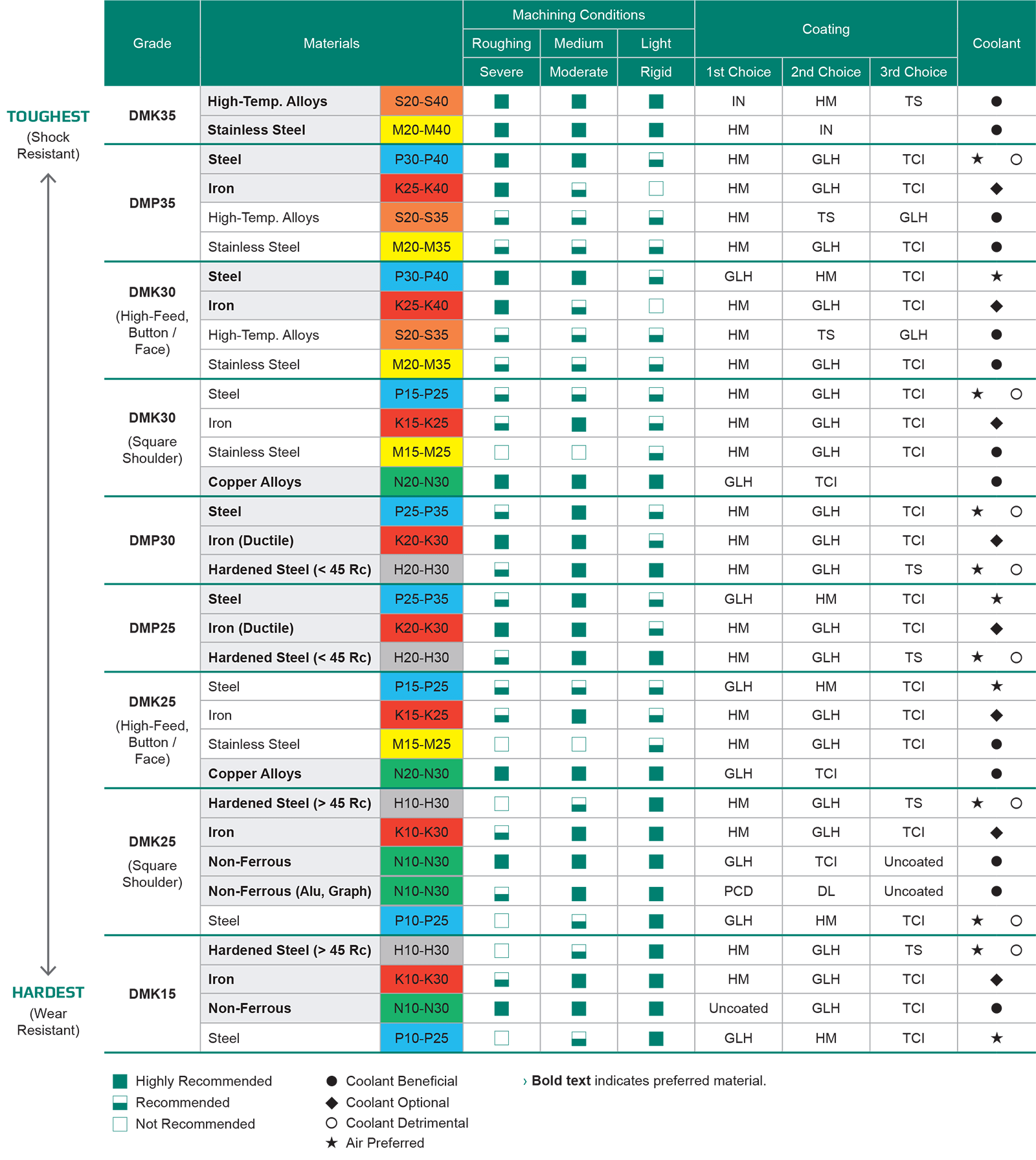
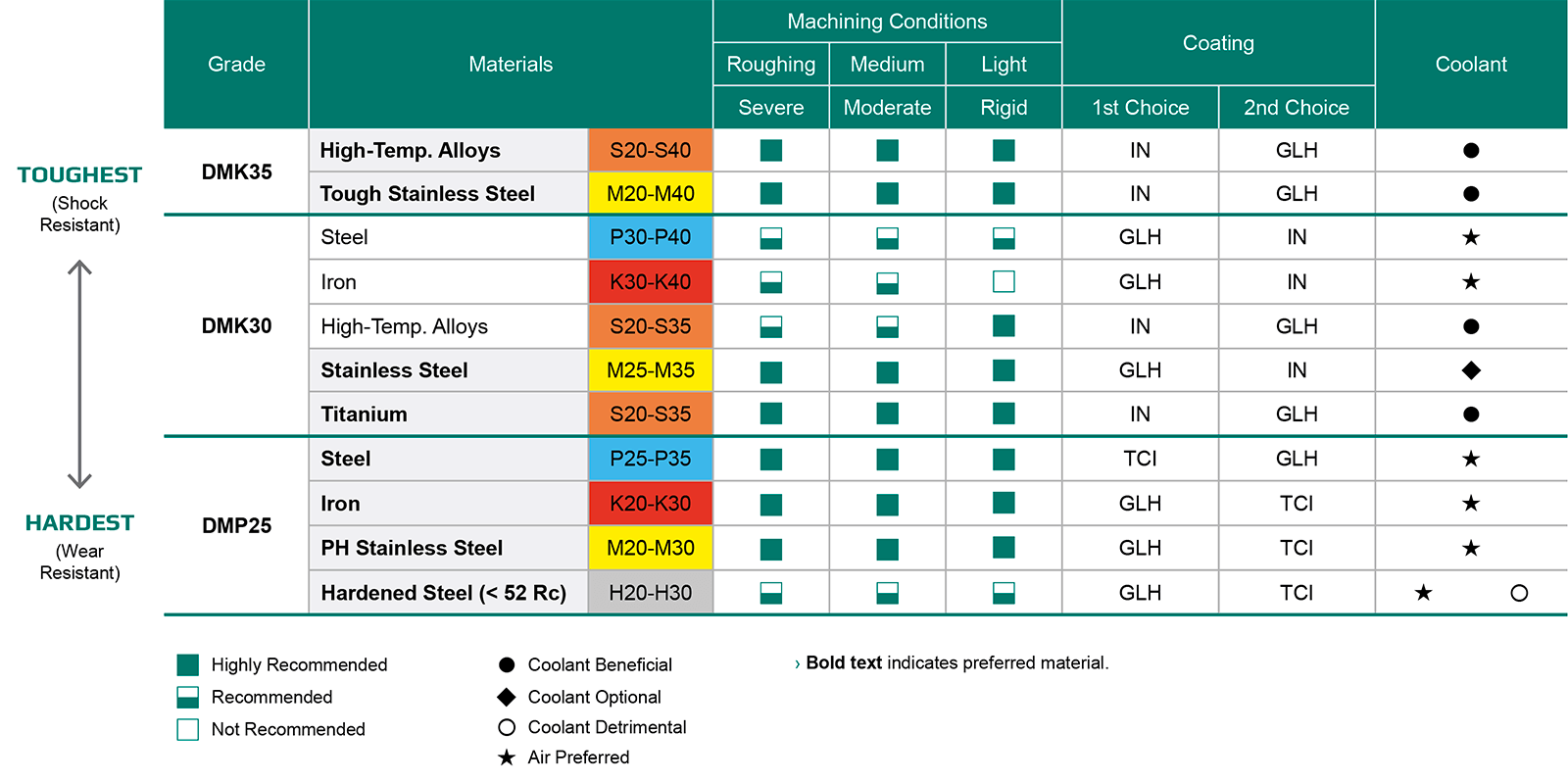
DMP35 Extreme toughness for high-shock applications involving interrupted cuts, long tool overhang or very heavy cuts. ANSI C1, ISO P40, M30-M40
DMP353 DMP35 substrate with a PVD TiCN coating. Excellent resistance to cratering and flank wear for light roughing when increased feed is possible. Best suited to carbon and alloy steels or low- to medium-speed stainless steel applications
DMP35-HP High-performance medium-temperature grade. Optimum performance and wear resistance in most soft steels, soft stainless steels and cast iron.
DMP357 DMP35 substrate with a PVD AlTiN coating. Excellent resistance to oxidation for high-speed cutting when increased surface speed is possible. Good coating for tool steels, heat-treated materials and higher-speed stainless steel applications.
DMP35-GLH Premium high-temperature grade. Unbeatable performance and wear resistance in high-heat applications such as harder steels, tough stainless steels and high-temperature alloys.
MEDIUM
Shock and Wear
DMP30 Tough and wear resistant. Optimum grades for high-speed machining of most steels. ANSI C5-C6, ISO P25-P35, M25-M35
DMP303 DMP30 substrate with our medium-temperature TiCN PVD coating; excellent for low-to-medium operating speeds where toughness and good wear resistance are expected.
DMP30-HP High-performance medium-temperature grade. Optimum performance and wear resistance in most soft steels, soft stainless steels and cast iron.
DMP307 DMP30 substrate with our high-temperature AlTiN PVD coating; use for high-speed machining, heavy roughing and semi-finishing applications.
DMP30-GLH Premium high-temperature grade. Unbeatable performance and wear resistance in high-heat applications such as harder steels, tough stainless steels and high-temperature alloys.
HARDEST
Wear Resistance
DMK25 Highest wear resistance with reduced shock absorption capabilities. Micro-grain carbide provides excellent edge strength for abrasive applications in nonferrous materials. Suitable for castings, aluminum and smoother cuts in tough stainless steels and high-temperature alloys. ANSI C2-C3, ISO K10-K25
DMK253 DMK25 substrate with PVD TiCN coating. Excellent resistance to built-up edge in aluminum and copper alloys.
DMK25-HP High-performance medium-temperature grade. Optimum performance and wear resistance in most soft steels, soft stainless steels and cast iron.
DMK257 DMK25 substrate with PVD AlTiN coating. Appropriate for higher-temperature applications such as high-velocity cast iron machining, tougher stainless steels, high-temperature alloys and high-speed copper alloy machining. Excellent for hard milling.
DMK25-GLH Premium high-temperature grade. Unbeatable performance and wear resistance in high-heat applications such as harder steels, tough stainless steels and high-temperature alloys. Excellent for hard milling.
APET & XPET Geometry Selection
APET Geometry Traits XPET Geometry
Positive/negative cutting edge with T-land Cutting Edge Positive cutting edge with a light hone and no T-land
Somewhat free-cutting; meant for higher chiploads (>.005" IPT); creates medium burr Cutting Action Free-cutting, small burr; can run at lighter chiploads (>.002" IPT)
Higher force due to negative edge; will deflect more than XPET Force Lower force due to sharper edge; less deflection
Higher heat generation than XPET; creates more heat at higher speeds Heat Less heat generated due to positive edge
Very strong cutting edge; able to withstand more shock and interruptions Strength Weaker, due to edge sharpness; not able to withstand significant interruptions
Longer edge life due to strong cutting edge; will roll more burr and wear out rather than chip out Edge Life Shorter, due to edge sharpness; may chip out if run too long
APET & XPET Grade Selection
Traits DMP35 DMP30 DMK25
Toughness (Fracture) Very tough, able to withstand shock and interruptions Tough and hard; not as tough as DMP35, but tougher than DMK25 Not as tough; may fracture in abusive applications
Wear Resistance (Edge Life) Softer carbide, will not last as long as DMK25 Longer life than DMP35, but shorter than DMK25 Longer edge life due to higher carbide hardness
Heat Resistance Lower heat resistance due to lower hardness of carbide Higher heat resistance than DMP35, less than DMK25 Highest heat resistance
Resistance to Built-Up Edge Fair resistance to built-up edge; some buildup may occur – use coolant as a preventative Poorer resistance to built-up edge; not typically a stainless steel grade Good resistance
Feed Capability High, due to toughness Strong feed capabilities, approx. 20% lower than DMP35 Lower, due to brittleness; run at higher speeds and lower feeds
Coolant Capability Good; toughness gives it more resistance to thermal shock Fairly tough; will allow machining with good coolant flow Not as high; may experience thermal shock unless coolant flow is very good
Choose the Best Grade for Your Application
Material Operating Speed Geometry 1st Choice Grade* Coolant
Free machining, low-carbon steels Low to Medium XPET DMP303 Air/Flood
Free machining, low-carbon steels Higher XPET DMP30-HP Air
Medium-carbon steels, tool steels Low to Medium APET/XPET** DMP303 Air/Flood
Medium-carbon steels, tool steels Higher APET/XPET** DMP30-GLH Air
All steels – interrupted cuts and heavy roughing cuts All APET DMP35-HP Air
Heat-treated steels (48-62 Rc) Low to Medium APET DMK25-GLH Air
Soft stainless steels (303, 304) Low to Medium XPET DMP303 Air/Flood
Soft stainless steels Higher XPET DMP30-GLH Air/Flood
Tough stainless steels (304L, 316, 400 series and PH series) Low to Medium XPET DMP35-GLH Flood
Tough stainless steels Higher XPET DMP35-GLH Flood
Cast iron All APET DMK25-HP Air
Aluminum alloys, copper alloys All XPET-ALU
XPET-PCD
DMK25/DMK253 Flood
High-temperature alloys, titanium All XPET DMP35-GLH Flood

* Only one grade (except for aluminum) suggested. Contact Applications Specialist if first choice doesn't work.

** Customer preference. Both are acceptable – see cutting edge differences above.

Dapra 90° Square Shoulder products are made in the USA.