After determining the desired chip thickness (MMPT – see chart below), find the insert diameter and Depth of Cut intersection in the chart at right. Multiply the desired chip thickness by the factor shown in the chart. This will be the Adjusted Feed per Tooth (AFPT), resulting in a true chip thickness of the desired amount.
Example:
If using a 1" Toroid end mill with the 1/2" inserts @ .03" Depth of Cut (DOC), the factor for the chip thickness = 2.1.
So, if a chip thickness of .005" is desired, a feed rate of .0105" (.005 x 2.1) needs to be programmed into the machine tool.
or
Adjusted Feed per Tooth (AFPT) = chip thickness x chip thinning factor (from chart)
![]() |
|||||
![]() |
3/8" | 1/2" | 5/8" | 3/4" | |
|---|---|---|---|---|---|
| 0.005 | 4.4 | 5.0 | 5.6 | 6.1 | |
| 0.010 | 3.1 | 3.6 | 4.0 | 4.4 | |
| 0.015 | 2.6 | 2.9 | 3.3 | 3.6 | |
| 0.020 | 2.2 | 2.6 | 2.8 | 3.1 | |
| 0.025 | 2.0 | 2.3 | 2.6 | 2.8 | |
| 0.030 | 1.8 | 2.1 | 2.3 | 2.6 | |
| 0.035 | 1.7 | 2.0 | 2.2 | 2.4 | |
| 0.040 | 1.6 | 1.8 | 2.0 | 2.2 | |
| 0.050 | 1.5 | 1.7 | 1.8 | 2.0 | |
| 0.060 | 1.4 | 1.5 | 1.7 | 1.8 | |
| 0.075 | 1.3 | 1.4 | 1.5 | 1.7 | |
| 0.085 | 1.2 | 1.3 | 1.5 | 1.6 | |
| 0.100 | 1.1 | 1.3 | 1.4 | 1.5 | |
| 0.125 | 1.1 | 1.2 | 1.3 | 1.3 | |
| 0.150 | NR | 1.1 | 1.2 | 1.3 | |
| 0.180 | NR | NR | 1.1 | 1.2 | |
| 0.200 | NR | NR | NR | 1.1 | |
| >0.200 | NR | NR | NR | NR | |
For all Depths of Cut:
Multiply desired chip thickness by 1.4 for Adjusted (programmed) Feed per Tooth (AFPT).

Example:
For .007" chip thickness, feed @ .010" (.007 x 1.4 = .010)
High-feed milling creates significant chip thinning due to an extreme lead angle. Feed rates must compensate for this to maximize productivity. The figure at left shows an example of this condition. Use the chart below to determine the compensation factor by which to multiply the desired chip thickness to arrive at your actual feed per tooth (FPT).
| Depth of Cut | Compensation |
|---|---|
| Up to .030" | 5x |
| .030" - .040" | 4x |
| .040" - .050" | 3.5x |
Example: If cutting at .030" DOC and trying for a .010" chip thickness, multiply .010" x 5 = .050" FPT.

A – .050" DOC, Chip Thickness = .021"
B – .040" DOC, Chip Thickness = .018"
C – .030" DOC, Chip Thickness = .015"
D – at .060" FPT & DOC shown above
| Toroid Shell Mill Part Number |
Min. Hole Dia. | Max. Hole Dia.* |
|---|---|---|
| TRSM200-075-R4-4 | 3.25" | 4.00" |
| TRSM200-075-R5-3 | 3.06" | 4.00" |
| TRSM250-100-R5-4 | 4.06" | 5.00" |
| TRSM300-100-R4-6 | 5.25" | 6.00" |
| TRSM300-100-R5-5 | 5.06" | 6.00" |
| TRSM400-150-R4-7 | 7.25" | 8.00" |
| TRSM400-150-R5-6 | 7.06" | 8.00" |
Minimum Hole Dia.:
(Tool Dia. x 2) - (1.5 x Insert Dia.)
Maximum Hole Dia.:*
Tool Dia. x 2
* Not recommended. At this diameter, the center tip is at its maximum. It is suggested that you stay slightly under this number.
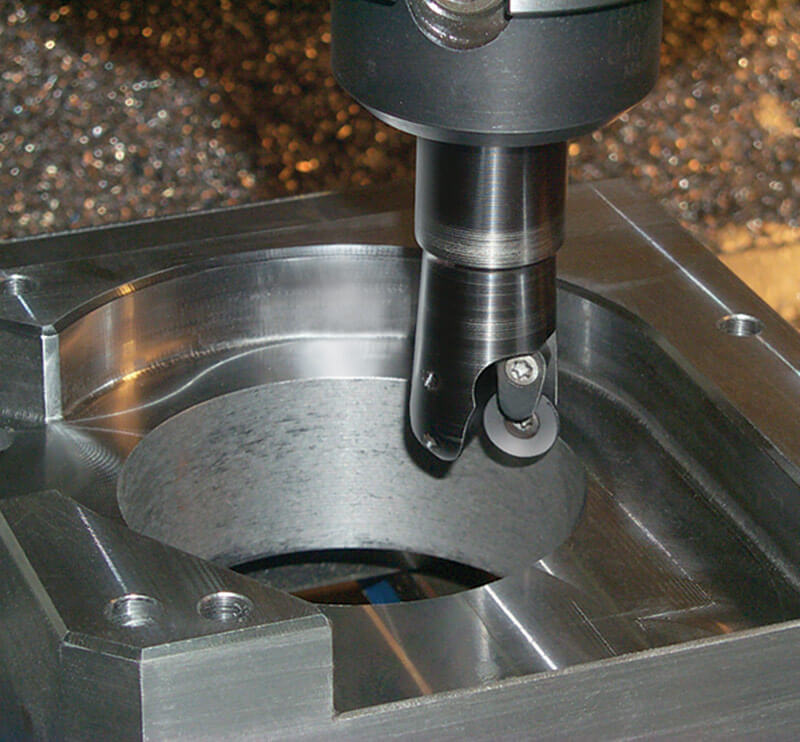
Larger diameter hole making can be quick and easy when a Toroid Cutter is used in combination with helical interpolation. This technique resembles thread milling in that all three axes (X, Y and Z) are in motion simultaneously. It differs from thread milling in that the tool is introduced into the material without a start hole of any kind. The tool simply is positioned at the inside diameter of the hole to begin its helix from there, achieving complete material removal from the hole by ramping down to the final depth. This smooth operation tends to avoid the high horsepower consumption characteristic of large diameter hole making. And with the high clearance angles of Toroid cutting tools, ramp angles during helical interpolation can be aggressive, without concern for rubbing the bottom of the cutting edge. This quick and easy process offers the added advantage of allowing many different hole sizes to be generated with the same diameter tool. Hole size variation is all in the programming.
Click here for more information on how Helical Interpolation can improve your manufacturing efficiency, or contact your Dapra Applications Specialist.
Click here or on the chart above for a larger version (opens in a new window).
This chart is also part of our Toroid catalog PDF.
| Concern | Possible Cause | Solutions |
|---|---|---|
| Insert wear appears high (flank wear) |
|
|
| Insert chipping |
|
|
| Built-up edge on insert |
|
|
| Poor finish/chatter |
|
|
| Tool shank breaks |
|
|
Dapra Toroid products are made in the USA.