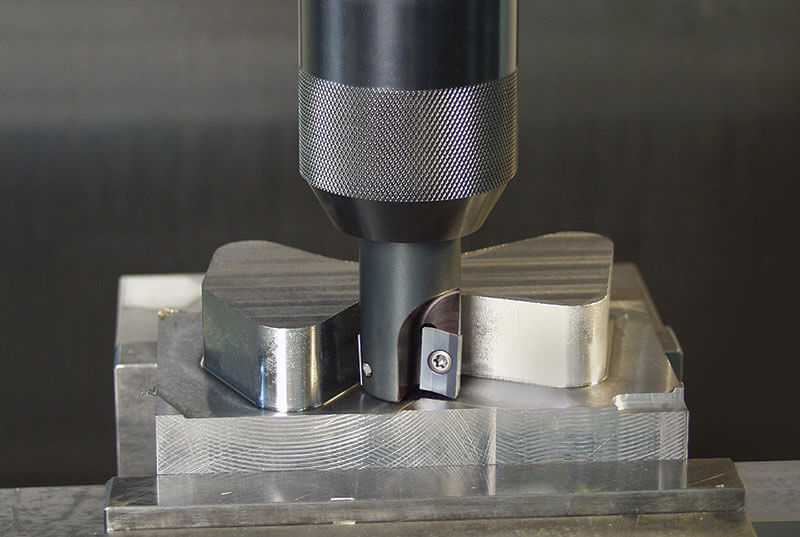
90° Square Shoulder Reference & Technical Information
Application Information
Technical Considerations
- Always use anti-seize compound on screws.
- Thoroughly clean pocket at each insert change.
- Change insert screw every 10 inserts.
- Use the shortest-length tool holder (end mill holder) for maximum rigidity. The shank of the cutting tool should be up inside the machine spindle taper whenever possible.
- Use tool holders appropriate for roughing operations: end mill holders and power chucks are recommended; collets are not recommended.
Recommendations
- Square Shoulder milling allows heavier Depths of Cut (DOC), but Dapra recommends that no more than 2/3 of the insert length should be engaged to reduce the chance for screw breakage.
- Although the cutter is capable of the heavier cut, take care to allow for the machine tool's capabilities in horsepower and rigidity.
- Utilize as much of the cutting edge per pass (DOC) as possible, to get the most metal removal within the insert's tool life
- Feed rates should not go significantly below or above the recommended ranges (see below), or premature failure can occur.
- Square Shoulder tools can not plunge; instead, use up to a 2° ramp angle for full diameter cut. Greater ramp angles possible with partial width cut.
- Climb milling is recommended whenever possible.
- Use the larger corner radii for the strongest cutting edge during roughing applications.
- Compensate for radial chip thinning (see below) when Width of Cut (WOC) is less than 50% of the cutter diameter.
- Because our Square Shoulder tools cut a true 90°, they are a good choice for a wide range of finishing applications.
- Use Coarse Pitch cutters for slotting cuts or when cutting pressure needs to be reduced; use Fine Pitch cutters for lighter profiling cuts or when feed rates can be maximized.
- Most of Dapra's high-performance grades run best without coolant. Coolant in most milling applications creates a high potential for thermal shock, which can produce premature, and sometimes catastrophic, failure. Use air pressure to provide adequate cooling and chip evacuation.
- For long-reach applications, utilize the Carbide Core cutting tools for increased rigidity and reduced chatter.
Optimizing Cutting Performance
Dapra's high-performance cutters work best when allowed to perform within their designed operating parameters. Adhering to the following steps will ensure that you are getting the most from your investment.
- Refer to the Feed and Speed Chart (see below) to find the recommended Surface Feet per Minute (SFM) and Feed per Tooth (FPT) at which to run your cutter, based on the material to be machined.
- Use the following formula to determine the Revolutions per Minute (RPM) for your cutting tool:
(SFM x 3.82) / Tool Dia. = RPM
Example: A 2" diameter tool operating at 900 SFM (900 x 3.82) / 2 = 1720 RPM
- Use the following formula to determine the feed in Inches per Minute (IPM) to be programmed into the machine tool: FPT x RPM x N (number of teeth in cutter) = Feed
Example: A 5-flute cutter at .008" FPT (.008 x 1720) x 5 = 69 IPM
- If the Width of Cut (WOC) < 1/2 the cutter diameter, use the feed rate compensation chart (below) to compensate for chip thinning.
Width of Cut
Width of Cut (WOC) (% of tool Ø)
| 50% or > |
40% |
30% |
20% |
10% |
| Feed Rate Multiplier |
1 |
1.02 |
1.1 |
1.25 |
1.7 |
After determining the percentage of WOC for the tool diameter, multiply the desired feed rate by the corresponding factor shown in the chart. This will be the Adjusted Feed per Tooth (AFPT) resulting in a true chip thickness of the desired amount.
Example: If using a 1" dia. end mill @ .100" WOC, the WOC = 10% of the cutter diameter.
Using the chart above, the factor for the chip thickness = 1.7.
If a chip thickness of .005" is desired, a feed rate of .0085" (.005 x 1.7) should be programmed into the machine tool.
or
Adjusted Feed per Tooth (AFPT) = desired chip thickness x chip thinning factor (from chart).
Hole Diameter Calculation
Hole Dia. Calculation
| Part Number |
Min. Hole Dia. |
Max. Hole Dia. |
| SSEM0500-0625-R35-1 |
0.56" |
1.00" |
| SSEM0625-0625-R35-2 |
0.78" |
1.25" |
| SSEM0750-0750-R35-2 |
1.03" |
1.50" |
| SSEM1000-1000-R55-2 |
1.28" |
2.00" |
| SSEM1250-1250-R55-3 |
1.78" |
2.50" |
| SSEM1500-1250-R55-3 |
2.28" |
3.00" |
| SSSM2000-0750-R55-5 |
3.28" |
4.00" |
| SSSM2500-1000-R55-5 |
4.28" |
5.00" |
| SSSM3000-1000-R55-6 |
5.28" |
6.00" |
| SSSM4000-1500-R55-8 |
7.28" |
8.00" |
| SSSM5000-1500-R55-8 |
9.28" |
10.00" |
| SSSM6000-1500-R55-10 |
11.28" |
12.00" |
Smaller holes may be interpolated by predrilling. Typical recommended ramp angle is 1° or less.
Helical Interpolation for Larger Diameter Hole Making
Larger diameter hole making can be quick and easy when a Square Shoulder Cutter is used in combination with Helical Interpolation. This technique resembles thread milling in that all three axes (X, Y and Z) are in motion simultaneously. It differs from thread milling in that the tool is introduced into the material without a start hole of any kind. The tool simply is positioned at the inside diameter of the hole to begin its helix from there, achieving complete material removal from the hole by ramping down to the final depth. This smooth operation tends to avoid the high horsepower consumption characteristic of large diameter hole making. The quick and easy process offers the added advantage of allowing many different hole sizes to be generated with the same diameter tool. Hole size variation is all in the programming.
Click here for more information on how Helical Interpolation can improve your manufacturing efficiency, or contact your Dapra Applications Specialist.
Recommended Cutting Speeds & Feeds for Square Shoulder Mills

Click here or on the chart above for a larger version (opens in a new window).
This chart is also part of our Square Shoulder catalog PDF.
Square Shoulder Troubleshooting
Troubleshooting
| Concern |
Possible Cause |
Solutions |
| Insert wear appears high (flank wear) |
- Not enough chip load
- Surface footage is high
- Incorrect grade or coating
|
- Verify correct speed and feed
- Increase feed rate
- Decrease RPM
- Consider different insert
|
| Insert chipping |
- Surface footage is low
- Incorrect grade or coating
- Using sharp edge insert incorrectly
- Feed too high
|
- Verify correct speed and feed
- Increase spindle speed
- Decrease feed rate
- Change insert selection
- Decrease DOC
|
| Built-up edge on insert |
- Low surface footage
- Light chip load (feed per tooth
- Incorrect coating
|
- Verify correct speed and feed
- Increase cutting speed
- Increase feed rate
- Select different coating
|
| Poor finish/chatter |
- Cutter hung out too far
- Excessive runout
- Inadequate tool holding
|
- Reduce tool gage length
- Check tool holder wear
- Use high-rigidity tool holder
|
| Tool shank breaks |
- Tool pressure too great
- Fatigued cutter body
|
- Decrease DOC
- Reduce tool gage length
- Decrease feed rate
|
Dapra 90° Square Shoulder products are made in the USA.